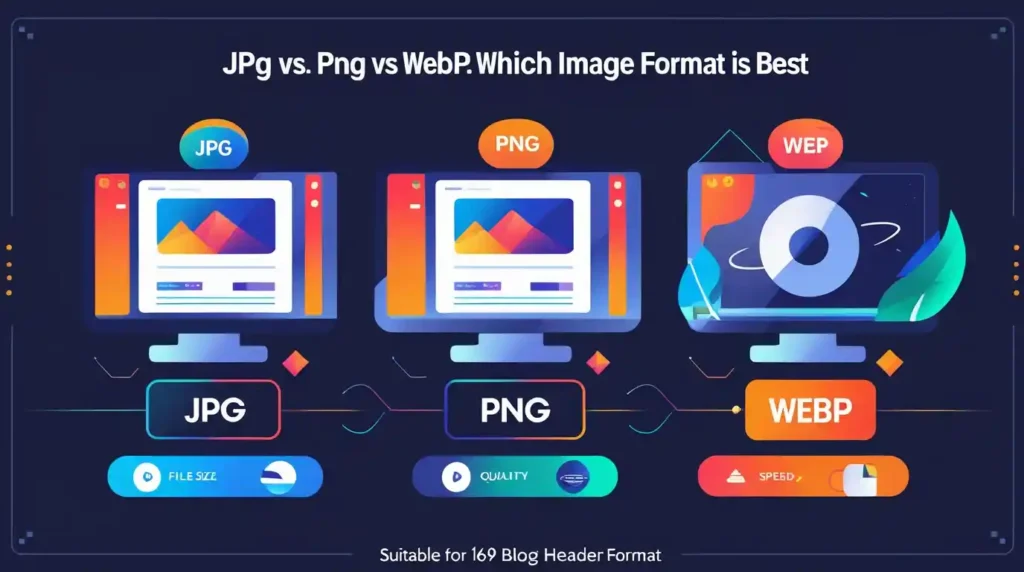
Every image you upload to your website carries a hidden cost — in loading time, bandwidth, storage, and SEO ranking. And a huge part of that cost comes down to one simple decision most people make without thinking: which image format to use.
JPG, PNG, and WebP are the three dominant image formats on the modern web. Each has genuine strengths and real weaknesses. Choosing the wrong one for your use case can slow down your website, hurt your Core Web Vitals scores, and silently damage your search engine rankings — without you ever realizing why.
This guide gives you the complete, honest image formats comparison — so you always know exactly which format to pick, and why.
What Are JPG, PNG, and WebP? A Plain-English Overview
Before comparing, let us understand what each format actually is and how it works.
What Is JPG (JPEG)?
JPG — which stands for Joint Photographic Experts Group — is the oldest and most widely used image format on the internet. It was designed specifically for photographs and complex color images and uses lossy compression, meaning it permanently discards some image data to achieve smaller file sizes.
The result is a format that is excellent for photography, blog images, and any visual content where a slight reduction in quality at high compression is acceptable in exchange for dramatically smaller file sizes.
What Is PNG?
PNG — Portable Network Graphics — was created as an open-source improvement over older formats. It uses lossless compression, meaning no image data is discarded during compression. Every pixel is preserved perfectly.
PNG’s defining feature is transparent background support — making it the go-to format for logos, icons, infographics, and UI elements where you need the background to be invisible against different page backgrounds.
What Is WebP?
WebP is a modern image format developed by Google and released in 2010. It was designed specifically to be the best image format for web performance — delivering better compression than both JPG and PNG while supporting transparency, animation, and both lossy and lossless compression modes.
According to Google’s official WebP documentation, WebP lossless images are 26% smaller than PNGs, while WebP lossy images are 25–34% smaller than comparable JPEGs — at equivalent visual quality. That is a dramatic improvement that directly impacts website speed and SEO rankings.
JPG vs PNG vs WebP — Complete Side-by-Side Comparison
Here is the most important comparison table you will find on this topic:
| Feature | JPG | PNG | WebP |
|---|---|---|---|
| Compression Type | Lossy | Lossless | Both (lossy & lossless) |
| File Size | Small | Large | Smallest |
| Transparency | ❌ No | ✅ Yes | ✅ Yes |
| Animation | ❌ No | ❌ No | ✅ Yes |
| Image Quality | Good (slight loss) | Perfect | Excellent |
| Browser Support | Universal | Universal | All modern browsers |
| Best For | Photos, blogs | Logos, graphics | Everything web-related |
| SEO Performance | Good | Moderate | Best |
| Core Web Vitals | Good | Poor (large files) | Best |
| WordPress Support | Native | Native | Via plugin/native (6.0+) |
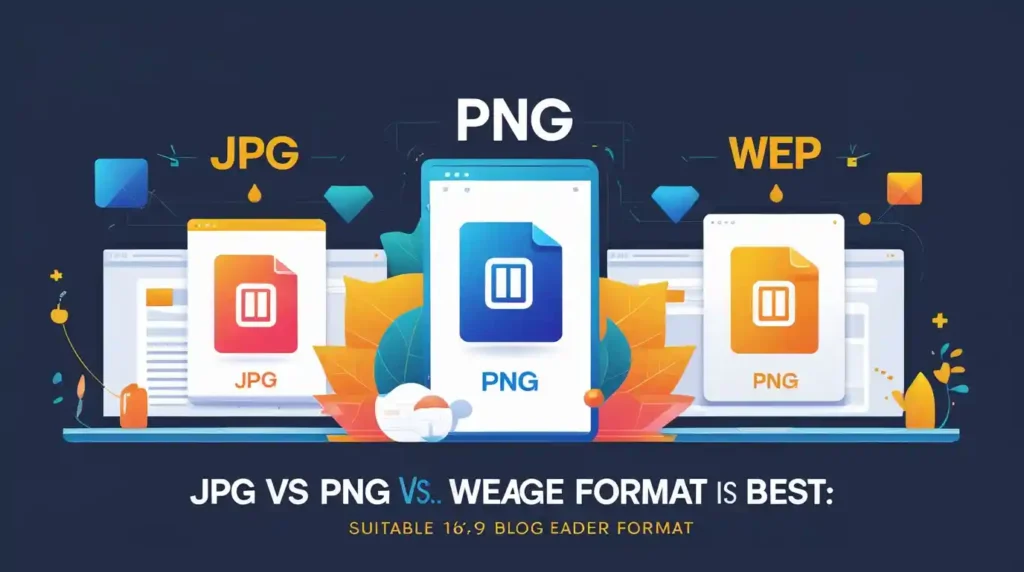
The takeaway is clear: WebP is the modern winner for web performance, but JPG and PNG remain the practical standard for most workflows in 2026.
JPG vs PNG: When to Use Each
Use JPG When:
- You are uploading photographs — travel photos, product shots, portraits, food images
- You need fast loading times and transparency is not required
- You are creating blog post images, featured images, or social media visuals
- You want to reduce image file size quickly without complex tools
- You are dealing with large image libraries where storage space matters
A typical high-resolution photograph saved as JPG at 85% quality might be 300–600 KB. The same photo saved as PNG could easily be 3–6 MB — ten times larger — with no visible improvement to the viewer.
Use PNG When:
- Your image requires a transparent background — logos, icons, overlays, stickers
- You are creating infographics, screenshots, or diagrams where text sharpness is critical
- You need lossless image quality for design assets that will be edited repeatedly
- You are working with flat-color illustrations with sharp, clean edges
- You need a source file that will be used as a master for future editing
A PNG logo on a website header will always look crisp against any background color — something JPG simply cannot deliver without a background color embedded into the image.
For quick format switching between these two, the JPG to PNG converter at Mega Free Tools and the PNG to JPG converter handle these conversions instantly — completely free, no registration needed.
Why WebP Is the Best Image Format for Website Speed and SEO
Let us talk about WebP seriously — because in 2026, it is no longer optional for performance-focused websites. It is the recommended standard.
WebP File Size Advantage
Here is a real-world comparison that illustrates the difference:
- A product photo saved as JPG (85% quality): ~280 KB
- The same photo saved as PNG: ~1.8 MB
- The same photo saved as WebP (80% quality): ~190 KB
WebP delivers the smallest file size while maintaining visual quality that is indistinguishable from JPG to the average viewer — and it supports transparency like PNG. It is genuinely the best of both worlds.
WebP and Core Web Vitals
Google’s Core Web Vitals — specifically Largest Contentful Paint (LCP) — directly measures how fast your main content loads. Images are almost always the LCP element on most web pages.
Switching from JPG/PNG to WebP can reduce your total image payload by 25–35%, which directly improves your LCP score, your PageSpeed Insights rating, and your overall search engine ranking position.
WebP Browser Support in 2026
A common concern used to be that WebP was not universally supported. That is no longer true. As of 2026, WebP is supported by:
- ✅ Google Chrome
- ✅ Mozilla Firefox
- ✅ Apple Safari (since version 14)
- ✅ Microsoft Edge
- ✅ Opera
- ✅ All modern mobile browsers
Over 97% of global web users are now on browsers that support WebP. For the small remaining percentage, you can serve JPG as a fallback using the HTML <picture> element.
WebP for WordPress Websites
WordPress natively supports WebP uploads since version 5.8. If you are running an older version or want automatic conversion of existing images, plugins like ShortPixel, Imagify, or EWWW Image Optimizer handle WebP conversion seamlessly in the background.
Which Image Format is Best for SEO?
This is the question that matters most for website owners who care about search rankings. Here is the direct answer:
For SEO in 2026, the priority ranking is: WebP > JPG > PNG
Here is why:
1. Page Speed is a Ranking Factor Google explicitly uses page loading speed as a ranking signal. Smaller image files (WebP) load faster, which improves Core Web Vitals, which improves rankings.
2. Mobile-First Indexing Google indexes the mobile version of your site first. Mobile users on slower connections benefit dramatically from WebP’s smaller file sizes. This directly affects how Google evaluates your page.
3. Image Search Ranking For appearing in Google Image Search, what matters is not the format but the alt text, file name, surrounding content, and image quality. A well-optimized JPG with descriptive alt text outranks a poorly optimized WebP every time.
4. User Experience Signals Faster loading means lower bounce rates and higher time-on-page — both positive signals to Google’s algorithm. WebP images contribute directly to these metrics.
The best SEO-friendly image format workflow is: use WebP for all web images, with descriptive file names and keyword-rich alt text on every image. For format conversion needs, the Image Compressor at Mega Free Tools and Image Resizer help you optimize your images before publishing.
JPG vs WebP for Ecommerce Product Photos
If you run an ecommerce store, product image format choices directly affect your conversion rates and page speed — both of which impact revenue.
The recommendation for ecommerce:
- WebP as primary format — delivers the best balance of quality and loading speed for product galleries
- JPG as fallback — for browsers that do not support WebP (increasingly rare in 2026)
- PNG only when needed — for product images requiring transparent backgrounds (e.g., products shown without background for layering)
Research consistently shows that product pages loading in under 2 seconds convert at double the rate of pages loading in 5+ seconds. Switching product images from JPG to WebP typically reduces image payload by 25–35%, which can translate directly into measurable conversion rate improvements.
For ecommerce sellers in Pakistan — particularly in Lahore, Karachi, and Islamabad — where a significant portion of shoppers browse on mobile networks, this performance advantage is even more pronounced.
PNG vs JPG for Transparency and Quality
This is a frequently asked comparison, particularly for designers and brand managers.
PNG wins clearly for transparency. If you need any part of an image to be see-through — so the page background shows through — you must use PNG (or WebP, which also supports transparency). JPG does not support transparency at all. Forcing a transparent image into JPG format fills the transparent areas with a solid color (usually white or black), which destroys the visual design.
PNG wins for quality. Because PNG uses lossless compression, logos, icons, and text-heavy graphics look sharper and cleaner in PNG than in JPG. Fine lines, sharp edges, and text characters are all preserved perfectly.
JPG wins for file size. For photographic content without transparency requirements, JPG’s lossy compression produces dramatically smaller files — typically 5–10x smaller than equivalent PNG files.
WebP wins overall. WebP handles transparency like PNG, delivers quality like PNG, but with file sizes closer to JPG. For new websites being built or redesigned in 2026, Web
How to Convert JPG or PNG to WebP
Converting your existing image library to WebP does not require expensive software. Here is how to do it at every skill level:
Free Browser-Based Conversion
Mega Free Tools offers the fastest free conversion tools for your everyday format needs:
- JPG to PNG — Convert JPEG images to PNG instantly
- PNG to JPG — Switch PNG to smaller JPEG format
- JPG to PDF — Compile JPG images into PDF documents
- PNG to PDF — Convert PNG graphics to PDF format
- PDF to JPG — Extract JPG images from PDF files
For WebP-specific conversion and optimization, the Toolify Worlds Image Compressor and Image Enhancer provide additional optimization options. Explore their full free tools library here.
WordPress Automatic Conversion
Install ShortPixel, Imagify, or EWWW Image Optimizer — all convert uploaded images to WebP automatically and serve them to supported browsers, with JPG/PNG fallback for older browsers.
Command Line (for Developers)
Google’s free cwebp command-line tool converts images to WebP with full quality control. Excellent for batch conversion of large image libraries.
Practical Quick-Reference Guide: Which Format to Choose
Here is the fastest possible reference for making the right format decision every time:
Use JPG when: → Photograph, blog image, product photo, social media post (no transparency needed)
Use PNG when: → Logo, icon, infographic, screenshot, anything needing transparent background
Use WebP when: → Any web image where you want the best possible combination of quality, file size, and loading speed
Still unsure? Default to WebP for new uploads. Use JPG for any system that does not support WebP yet. Reserve PNG exclusively for cases where you genuinely need transparency or lossless quality.
Image Format Tips for Pakistani Websites and Developers
For website owners, bloggers, and developers in Pakistan — including those building businesses in Karachi, Lahore, and Islamabad — image format optimization is one of the highest-impact improvements you can make for local audience performance.
Pakistani mobile internet speeds, while growing rapidly, still make loading time a critical factor. Switching from PNG to JPG or WebP on image-heavy pages can reduce loading times by 40–60% — a dramatic improvement that directly reduces bounce rates from Pakistani mobile visitors.
All the format conversion tools at Mega Free Tools work without VPN, without registration barriers, and without any payment — making them genuinely practical for everyday use by Pakistani creators and developers.
For Pakistani business owners who also need financial planning tools, Toolify Worlds offers a Pakistan Income Tax Calculator and Pakistan Business Tax Calculator alongside their digital utilities.
Complete Free Toolkit at Mega Free Tools
Mega Free Tools provides everything you need for professional image and document management — all completely free:
Image Format & Conversion Tools:
- 🔄 JPG to PNG — Instant format conversion
- 🔁 PNG to JPG — Smaller file format switching
- 🖼️ Image Compressor — Reduce file sizes dramatically
- 📐 Image Resizer — Set exact pixel dimensions
- 🖌️ Background Remover — Remove backgrounds automatically
- 💧 Watermark Remover — Clean up images instantly
- 🎨 Color Picker — Extract exact colors from images
PDF Tools:
- 📑 JPG to PDF — Convert images to PDF
- 📋 PNG to PDF — Graphics to PDF format
- 🖼️ PDF to JPG — Extract images from PDFs
- 🗜️ PDF Compressor — Reduce PDF file sizes
- ✂️ Split PDF — Separate PDF pages
- 🔀 Merge PDF — Combine multiple PDFs
- 📄 Word to PDF — Document conversion
- 📝 PDF to Word — Extract editable text
- 📃 Text to PDF — Plain text to PDF
Productivity Tools:
- 🔒 Password Generator — Secure password creation
- ✅ JSON Validator — Validate JSON data
- 📝 Online Notepad — Browser text editor
- 📊 Word Counter — Count words instantly
- 🔡 Case Converter — Switch text case
- 🔗 QR Code Generator — Generate QR codes
Explore everything on the Services page, learn more on the About Us page, or contact the team via the Contact page.
FAQ — JPG vs PNG vs WebP Quick Answers
What is the difference between JPG, PNG, and WebP? JPG uses lossy compression for small file sizes — best for photographs. PNG uses lossless compression with transparency support — best for logos and graphics. WebP combines both capabilities with even smaller file sizes — best for overall web performance.
Which image format is best for web? WebP is the best image format for web performance in 2026. It produces the smallest file sizes at equivalent quality, supports transparency, and is supported by all modern browsers. For workflows not yet supporting WebP, JPG is the next best choice.
Should I use WebP for my website? Yes — absolutely. WebP reduces image file sizes by 25–35% compared to JPG and PNG at equivalent quality, which directly improves loading speed, Core Web Vitals scores, and SEO rankings. WordPress supports WebP natively since version 5.8.
Is PNG better than JPG? PNG is better than JPG when you need transparent backgrounds or pixel-perfect lossless quality (logos, graphics, screenshots). JPG is better than PNG when you need smaller file sizes for photographs and web images where transparency is not required.
Does WebP improve page speed? Yes — significantly. WebP images are typically 25–35% smaller than equivalent JPG files and 26% smaller than equivalent PNG files. This reduction in image payload directly improves page loading speed, LCP scores, and overall Core Web Vitals performance.
How do I convert JPG or PNG to WebP? Use browser-based free tools for quick conversions. For format switching between JPG and PNG, the Mega Free Tools converters handle this instantly. For WebP conversion at scale, WordPress plugins like ShortPixel or EWWW Image Optimizer automate the process.
Which format is best for SEO images? WebP is the best format for SEO because its smaller file sizes improve page speed, which is a direct Google ranking factor. Regardless of format, always use descriptive keyword-rich alt text, descriptive hyphenated file names, and compress images before uploading.
Can WebP replace PNG and JPG? For web use — yes, WebP can replace both PNG and JPG in most scenarios. It handles transparency (like PNG), produces small files (better than JPG), and supports both lossy and lossless compression. The only limitation is compatibility with very old systems or software that does not support WebP.
Final Verdict — The Right Format for Every Situation
After comparing JPG vs PNG vs WebP across every dimension that matters — file size, quality, transparency, browser support, SEO performance, and practical usability — here is the clearest possible summary:
Choose JPG for photographs, blog images, product photos, and any visual content where transparency is not needed and loading speed matters.
Choose PNG for logos, icons, infographics, screenshots, and any content requiring transparent backgrounds or pixel-perfect lossless quality.
Choose WebP for maximum web performance — the best file size, the best quality balance, transparency support, and the best SEO outcomes. In 2026, WebP should be your default format for all new web images.
Whatever format you use, always compress and resize before uploading. The Image Compressor and Image Resizer at Mega Free Tools handle both tasks instantly and completely free — giving you the performance benefits of WebP-level optimization even when working with JPG or PNG files.
Make the right format choice. Your website speed, your SEO ranking, and your visitors will all reflect the difference.
Explore the complete free image and document toolkit at megafreetools.com/tools/ — professional results, zero cost, no registration required.