
Introduction
In the world of digital marketing, SEO (Search Engine Optimization) has become the primary necessity for every website owner. However, when it comes to SEO, most beginners find it challenging to understand what is the difference between On-Page SEO and Off-Page SEO. If you also want to rank your website on Google and are wondering which is more important between “On-Page SEO vs Off-Page SEO,” this article is specifically for you.
SEO is divided into two main categories: On-Page SEO and Off-Page SEO. Both have their distinct roles and importance in website ranking. Simply put, On-Page SEO is everything you do inside your website, while Off-Page SEO consists of activities you perform outside your website.
In this comprehensive guide, we’ll learn in detail what On-Page SEO is and what Off-Page SEO is, what’s the difference between them, which one is more important, and how you can effectively use both strategies to rank your website on Google.
What is On-Page SEO?
On-Page SEO (or On-Site SEO) refers to optimization techniques that you implement directly on your website pages to make your website better for both search engines and users. These are all the elements you can control within your website.
The main purpose of On-Page SEO is to improve your website’s content quality, structure, and technical aspects so that search engines can easily understand what your page is about and how relevant and valuable it is for users.
When Google or any other search engine crawls your website, it first examines your On-Page SEO factors. If your On-Page SEO is strong, your chances of getting good rankings in SERP (Search Engine Result Pages) increase significantly.
Important On-Page SEO Factors
To make On-Page SEO effective, there are several critical factors that every website owner should keep in mind:
Content Quality and Relevance – The content on your website should be high-quality, informative, and aligned with user intent. Google no longer ranks based solely on keyword stuffing but looks at the overall quality of content. You need to write original, well-researched, and comprehensive content that solves users’ problems.
Title Tag Optimization – This is the most important On-Page SEO element of your page. The title tag is the heading that appears in search results. You should naturally include your primary keyword in it, and it should be between 50-60 characters. Attractive and click-worthy title tags increase CTR (Click Through Rate).
Meta Description – This is a 150-160 character short summary that appears below your title in search results. Although it’s not a direct ranking factor, a good meta description improves CTR, which indirectly affects ranking.
Header Tags (H1, H2, H3) – Headers organize content and help search engines understand page structure. The H1 tag should be used only once (for the page title), while H2 and H3 tags should be used logically to divide content into sections. Naturally include secondary keywords in these.
Keyword Optimization and Density – Keywords should be naturally spread throughout the content. A keyword density of 1-2% is ideal. Make sure to mention the primary keyword in the first 100 words. Use LSI keywords and semantic keywords to make content comprehensive.
URL Structure – URLs should be short, descriptive, and keyword-rich. Clean URLs are user-friendly and better for search engines too. For example: megafreetools.com/on-page-seo-vs-off-page-seo is a good URL structure.
Internal Linking Strategy – Linking relevant pages of your website together is called internal linking. It improves user experience, distributes page authority, and helps search engine crawlers better understand your website.
Image Optimization – Optimizing images is essential. Every image should have a descriptive file name and ALT text containing relevant keywords. Compress images to reduce file size so page speed stays fast. Using WebP format improves performance.
Mobile-Friendliness – Google now uses mobile-first indexing, meaning it prioritizes the mobile version first. Your website should be responsive and look and function well on every screen size.
Page Speed and Core Web Vitals – Website loading speed is a very important ranking factor. Core Web Vitals (LCP, FID, CLS) should be optimized. Fast loading pages improve user experience and reduce bounce rate.
Schema Markup and Structured Data – Schema markup helps search engines better understand your content’s context. It increases chances of getting rich snippets and featured snippets.
Content Length and Depth – Detailed, comprehensive content generally ranks better. A minimum of 1500-2000 words of content is recommended for competitive keywords. However, quality should never be compromised.
What is Off-Page SEO?
Off-Page SEO encompasses all activities and techniques you perform outside your website to increase your website’s authority, trust, and popularity. This primarily focuses on building your website’s backlink profile and online presence.
Off-Page SEO mainly focuses on link building, but it’s not limited to that. Social signals, brand mentions, guest posting, influencer outreach, and online reputation management are also important parts of Off-Page SEO.
By examining Off-Page SEO factors, search engines determine how authoritative, trustworthy, and popular your website is. If many high-quality websites are linking to you, search engines understand that your content is valuable.
Important Off-Page SEO Factors
To make your Off-Page SEO strategy successful, focusing on these factors is essential:
Backlinks (Incoming Links) – This is the most important factor of Off-Page SEO. Backlinks are links from other websites pointing to your website. Getting backlinks from high-quality, relevant websites increases domain authority and page authority. Quality is more important than quantity – one authoritative website’s backlink is better than thousands of low-quality links.
Link Quality and Relevance – It’s not just about the number of backlinks. You need to check the quality of links. Links from relevant niche websites are more valuable. Links from spam or low-quality websites can harm your ranking.
Anchor Text Optimization – Anchor text is the clickable text used in a link. You should use natural and varied anchor text. Too much exact-match anchor text can become a spam signal. A mix of branded, generic, and partial-match anchor text is healthy.
Domain Authority and Page Authority – These metrics (developed by Moz) measure your website’s overall strength. Getting backlinks from high DA/PA websites significantly boosts your ranking.
Social Signals and Engagement – Sharing, likes, comments, and engagement of your content on social media platforms are also ranking factors. Although not a direct ranking factor, social signals indicate your content’s popularity and reach, which indirectly helps SEO.
Guest Blogging and Posting – By writing guest posts on relevant blogs, you can earn quality backlinks and build authority in your niche. Guest posting also brings targeted traffic.
Brand Mentions and Citations – When people mention your brand name online (with or without a link), it’s also an Off-Page SEO signal. Google also tracks unlinked brand mentions.
Forum Participation and Community Engagement – By being active in relevant forums, Q&A sites (like Quora), and online communities, you can showcase your expertise and generate quality traffic and backlinks.
Influencer Outreach and Collaborations – By collaborating with influencers in your industry, you can expand your reach and gain quality backlinks and brand exposure.
Online Reviews and Reputation – Positive reviews on Google My Business, Yelp, and other review platforms improve your online reputation, which is beneficial for local SEO and overall authority.
Content Promotion and Distribution – Promoting your content on different channels (social media, email marketing, content syndication) generates traffic and naturally attracts backlinks.
On-Page SEO vs Off-Page SEO: Detailed Comparison
To better understand both SEO strategies, here’s a comprehensive comparison table:
| Aspect | On-Page SEO | Off-Page SEO |
|---|---|---|
| Definition | Optimization activities inside the website | Promotional activities outside the website |
| Control | Complete control in your hands | Limited control, depends on others |
| Main Focus | Content quality, keywords, technical optimization | Link building, authority building, promotion |
| Implementation Time | Can be implemented quickly | Time-consuming process, takes time for results |
| Direct Impact | Directly improves content and structure | Builds website authority and trust |
| Primary Activities | Content creation, meta tags, internal linking, site speed | Backlink building, social media, guest posting |
| Measurability | Easily measurable through tools | Slightly complex measurement |
| Cost | Generally low-cost or free | Variable – from free to expensive |
| Results Timeline | Comparatively faster results | Long-term strategy, requires patience |
| Dependencies | Self-dependent, you control everything | Depends on third-party websites and platforms |
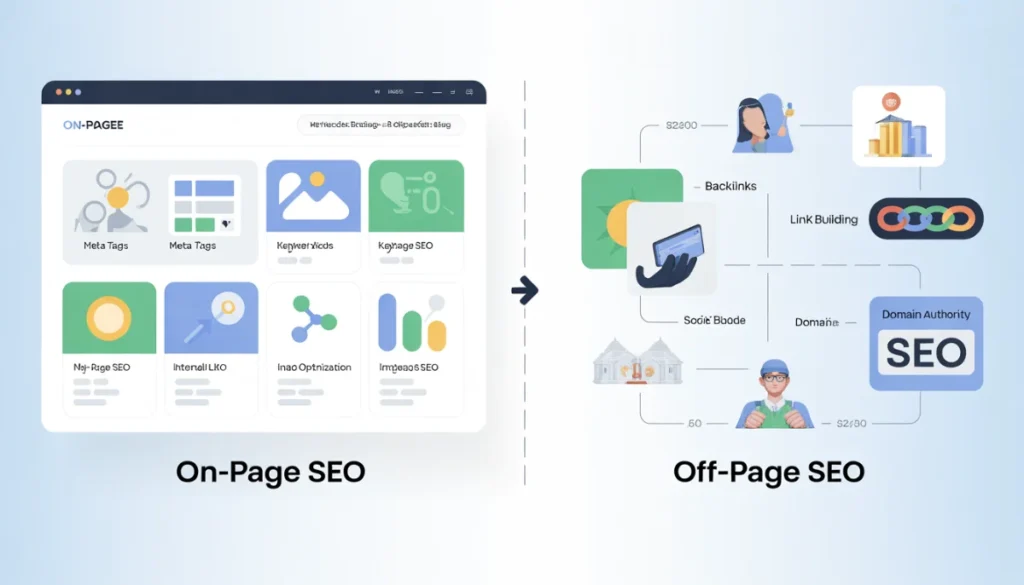
Difference from Technical Perspective
On-Page SEO covers more technical and structural aspects. Here you optimize your website’s code, content, and architecture. Technical SEO is also part of On-Page SEO, which includes crawling, indexing, site architecture, structured data, and website security. You can easily track your On-Page efforts with Google Search Console and analytics tools.
Off-Page SEO focuses more on marketing and relationship building. It’s an organic and natural process that requires consistent effort and networking. Link acquisition, content marketing, and brand building are long-term strategies that gradually develop website authority.
User Experience Perspective
On-Page SEO directly improves user experience. Fast loading pages, mobile-friendly design, clear navigation, and quality content encourage users to spend more time on the website. This reduces bounce rate and increases engagement.
Off-Page SEO indirectly affects user experience. When users find your reference on other trusted websites, their trust in you increases. Social proof and recommendations improve conversion rates.
Which is More Important: On-Page or Off-Page SEO?
This is the most common question that comes to every beginner’s mind. The simple answer is that both are equally important, and for an effective SEO strategy, a combination of both is necessary.
Priority of On-Page SEO
If you’re starting your SEO journey, focus on On-Page SEO first. Because:
If your website’s foundation is weak, Off-Page SEO won’t help. Without quality content and proper optimization, even backlinks won’t work. Google crawlers first analyze your On-Page factors. If those aren’t up to standard, further optimization becomes meaningless.
On-Page SEO is completely in your control. You can make changes whenever you want and see improvements. Technical issues, poor content, or slow loading speed should be fixed first.
For new websites, On-Page SEO is the foundation. Until your website is properly optimized, Off-Page efforts can be wasted.
Necessity of Off-Page SEO
But On-Page SEO alone won’t work either, because:
For competitive keywords, a strong backlink profile is essential. If your competitors have high DA/PA, you need to increase your Off-Page efforts too.
Brand awareness and online presence are built only through Off-Page activities. Social media engagement, guest posts, and influencer collaborations exponentially increase your reach.
Google now focuses heavily on E-E-A-T (Experience, Expertise, Authoritativeness, Trustworthiness). These qualities are primarily demonstrated through Off-Page signals like backlinks from authoritative sites and brand mentions.
Balanced Approach
The ideal strategy is to first perfect your On-Page SEO, then gradually start Off-Page activities. Running both in parallel gives the best results.
A solid foundation (On-Page) + consistent promotion and authority building (Off-Page) = Sustainable long-term rankings
How to Do On-Page SEO: Step-by-Step Guide
If you want to systematically improve your website’s On-Page SEO, follow these steps:
Step 1: Conduct Keyword Research – Use tools like Google Keyword Planner, Ubersuggest, or Ahrefs to find relevant keywords. Identify primary, secondary, LSI, and long-tail keywords related to your niche.
Step 2: Create Quality Content – Write comprehensive, well-researched, and original content. Understand user intent and structure content accordingly. Add visual elements (images, infographics, videos) to make content engaging.
Step 3: Optimize Title and Meta Tags – Create unique and compelling title tags for every page that naturally include the primary keyword. Write informative and action-oriented meta descriptions.
Step 4: Structure Headers Properly – Use H1, H2, H3 tags logically. Proper heading structure is essential to make content scannable. Naturally include secondary keywords in headers.
Step 5: Make URLs SEO-Friendly – Use short, descriptive URLs that reflect page content. Avoid special characters and unnecessary parameters.
Step 6: Implement Internal Linking Strategy – Strategically link related pages. Anchor text should be relevant and natural. Avoid orphan pages (not linked from anywhere).
Step 7: Optimize Images – Use descriptive file names and ALT text. Compress images to reduce size without compromising quality. Prefer next-gen formats (WebP).
Step 8: Check Technical SEO – Verify site speed, mobile-friendliness, SSL certificate, XML sitemap, robots.txt – all of these. Use tools like Google Search Console and PageSpeed Insights.
Step 9: Add Schema Markup – Implement appropriate schema types (Article, FAQ, Product, etc.) to get rich snippets.
Step 10: Conduct Regular SEO Audits – Audit your website monthly or quarterly. Identify and fix issues. Analyze competitors and improve your strategy.
How to Do Off-Page SEO: Guide for Beginners
To effectively do Off-Page SEO, follow these proven strategies:
Build Quality Backlinks – Do guest posting on high-authority blogs, use broken link building technique, apply resource page link building strategy. Remember: one quality backlink is better than a hundred low-quality links.
Strengthen Social Media Presence – Be active on all major platforms (Facebook, Twitter, LinkedIn, Instagram). Share valuable content regularly. Have genuine engagement with audience – reply to comments, participate in discussions.
Develop Content Marketing Strategy – Create shareable and link-worthy content like infographics, original research, case studies, comprehensive guides. Reach out to influencers and bloggers to promote content.
List in Online Directories – Submit your website to Google My Business, Bing Places, and industry-specific directories. Maintain consistent NAP (Name, Address, Phone) information.
Be Active on Q&A Sites – Provide genuinely helpful answers on platforms like Quora, Reddit, Stack Exchange. You can add your website link in signatures (don’t spam).
Analyze Competitor Backlinks – Analyze your competitors’ backlinks with tools like Ahrefs or SEMrush. Improve your strategy by looking at their link building strategies.
Track Brand Mentions – Set up Google Alerts for your brand name. Where there are unlinked mentions, request to add links.
Increase Local SEO Efforts – If you have a local business, focus on local citations, local directories, and local link building.
SEO Strategy: Perfect Combination of On-Page and Off-Page
To create a successful SEO strategy, effectively combining both approaches is essential:
Month 1-2: On-Page Foundation – Fix technical issues by auditing the website, create quality content, do proper optimization, improve internal linking structure.
Month 3-4: Initial Off-Page Efforts – Set up social media profiles, acquire easy backlinks (directories, profiles), search for guest post opportunities.
Month 5-6: Aggressive Content Marketing – Regularly publish high-quality long-form content, promote content on multiple channels, start influencer outreach.
Month 7+: Scaling and Consistency – Continue content creation, sustain link building efforts, monitor analytics and refine strategy, adopt emerging SEO trends.
Avoid Common Mistakes
Never do keyword stuffing – maintain natural flow. Avoid acquiring low-quality backlinks – these can cause penalties. Don’t ignore mobile optimization – majority of traffic comes from mobile. Avoid duplicate content – only unique content is valuable. Don’t compromise user experience in pursuit of optimization.
Conclusion
On-Page SEO and Off-Page SEO are both essential pillars for successful website ranking. On-Page SEO is your website’s foundation that ensures content quality, technical optimization, and user experience. Off-Page SEO establishes your website’s authority, trust, and popularity.
If you want to rank your website on Google, adopt a balanced approach: first build a strong On-Page foundation, then grow your authority with consistent Off-Page efforts. Remember, SEO is a marathon, not a sprint. Be patient, focus on quality, and work consistently.
Google ranking factors are constantly evolving, so staying updated and refining your strategy is essential. Don’t ignore modern ranking factors like Core Web Vitals, E-E-A-T signals, and user experience.
Now you clearly understand what is the difference between On-Page and Off-Page SEO and how to effectively use both to increase your website’s organic traffic. Start today, and experience seeing your website on Google’s first page!
Frequently Asked Questions (FAQs)
Is On-Page SEO more important or Off-Page SEO?
Both are equally important for successful ranking. On-Page SEO is your website’s foundation while Off-Page SEO builds authority. The ideal approach is to first perfect On-Page, then start Off-Page efforts. Without a strong foundation (On-Page), Off-Page efforts won’t give maximum results. A balanced combination of both gives the best results.
Can a website rank without backlinks?
Yes, ranking is possible without backlinks for low-competition keywords if your On-Page SEO is exceptional. However, for medium to high competition keywords, quality backlinks are necessary. By focusing on niche topics and long-tail keywords, you can generate traffic initially without extensive link building. Gradually, as your content quality shows, backlinks will start coming naturally.
What is included in On-Page SEO?
On-Page SEO includes: quality content creation, title tags and meta descriptions optimization, proper use of header tags, natural keyword optimization, URL structure improvement, internal linking strategy, image optimization with ALT text, ensuring mobile-friendliness, page speed improvement, schema markup implementation, technical SEO aspects like XML sitemap and robots.txt, and Core Web Vitals optimization. Basically, everything you can control inside your website is part of On-Page SEO.
What is the most important factor of Off-Page SEO?
Quality backlinks are the most critical factor of Off-Page SEO. Natural backlinks from high-authority and relevant websites significantly increase your domain authority. However, relying only on backlinks isn’t right – brand mentions, social signals, online reviews, and overall online reputation are also important Off-Page factors. Quality is always more important than quantity in backlinks.
How long does SEO take to show results?
SEO results timeline depends on various factors like competition level, domain age, current website state, and consistency of your efforts. Generally, new websites can take 6-12 months to see first significant results. On-Page changes start showing effects in 2-4 weeks. Off-Page efforts’ impact appears in 3-6 months because Google takes time to validate backlinks and assess authority. Established websites can see results comparatively faster (2-4 months). Remember, SEO is a long-term investment – patience and consistent effort are essential.
This article is published on Mega Free Tools. If you found this guide helpful, please share it and implement these strategies in your SEO journey to share your results!