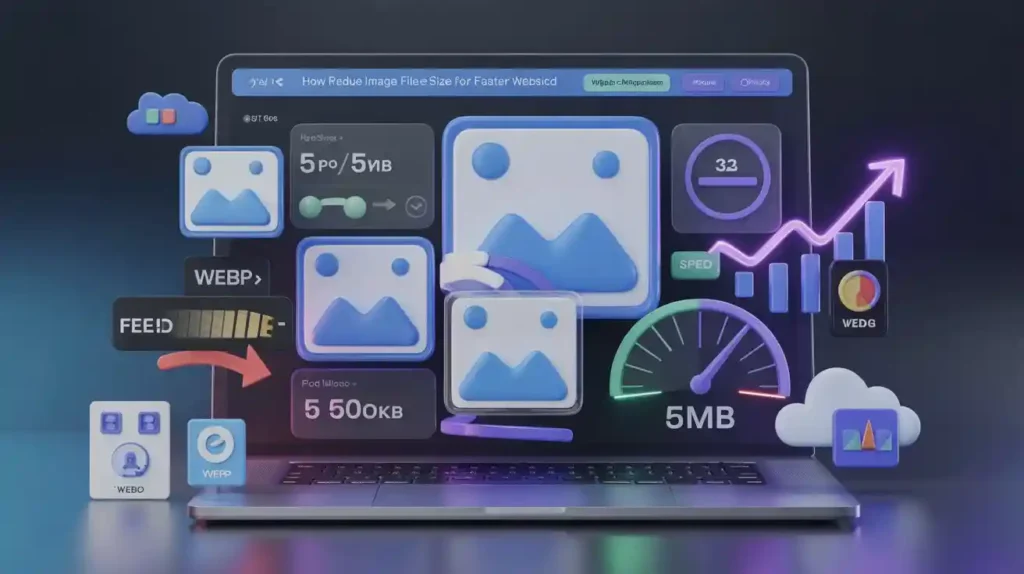
If your website loads slowly, there is a good chance your images are the main culprit. Large, unoptimized images are one of the biggest reasons websites lose visitors, drop in Google rankings, and deliver a poor user experience. Whether you run a blog, an eCommerce store, or a business website in Pakistan, website speed optimization starts with one simple step — learning how to reduce image file size the right way.
In this guide, you will learn everything about image compression, the best tools available, and practical tips to optimize images for web without sacrificing quality. Let us get started.
What Is Image Compression and Why Does It Matter?
Image compression is the process of reducing the file size of an image by removing unnecessary data. This can be done in two ways — lossless and lossy compression.
Lossless image compression reduces file size without any quality loss. Every pixel remains exactly as it was. Lossy image compression, on the other hand, permanently removes some image data to achieve much smaller file sizes. For most websites, a carefully applied lossy compression delivers results that look identical to the naked eye but load dramatically faster.
When you compress images for website use, you are essentially making your pages lighter. A page that loads in under two seconds retains significantly more visitors than one that takes five seconds or more. According to Google, as page load time increases from one second to five seconds, the probability of a mobile visitor bouncing increases by 90%.
So yes — image optimization is not just a technical task. It directly affects your revenue, your SEO ranking, and your user satisfaction.
Why Website Speed and Image Optimization Matter in Pakistan
Pakistani businesses, freelancers, and bloggers often overlook website speed optimization because they focus more on design and content. However, with mobile internet usage growing rapidly across Karachi, Lahore, and Islamabad, page load speed has become more critical than ever.
Mobile connections in Pakistan can be slower than fiber broadband connections in other countries. This means if your images are large and uncompressed, your Pakistani audience is likely experiencing frustrating load times every time they visit your website.
Website speed directly impacts:
- Google search rankings (Google confirmed page speed is a ranking factor)
- User engagement and time on site
- Bounce rate reduction
- Conversion rates for online stores and service businesses
- Mobile website optimization performance
If you are a Pakistani blogger, freelancer, or small business owner, optimizing your images is one of the most cost-effective ways to improve your website’s performance without spending money on expensive hosting upgrades.
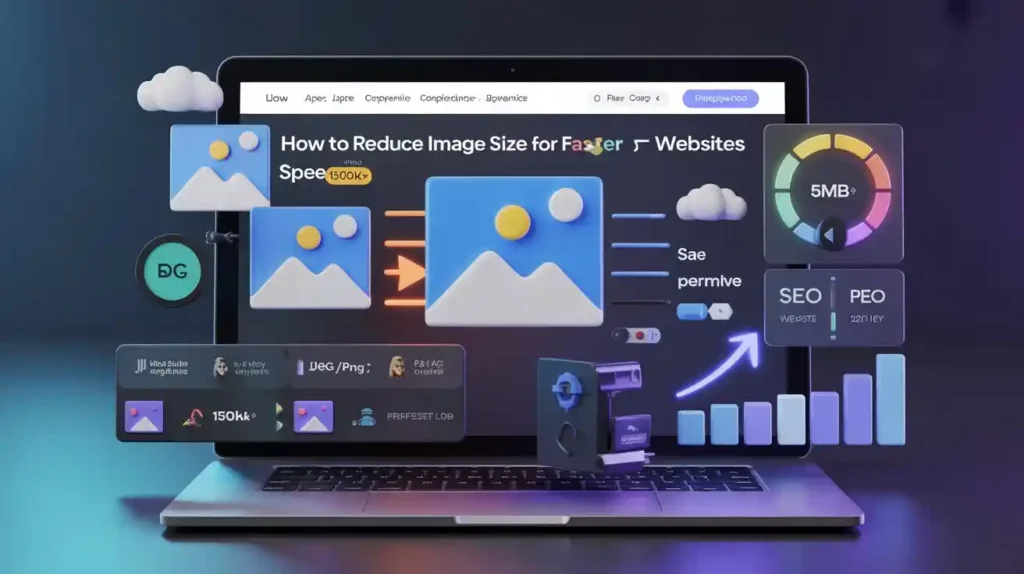
JPEG, PNG, and WebP — Which Format Is Best for Web Speed?
Choosing the right image format is the first step before you even start compressing. Here is a simple breakdown:
JPEG (JPG): Best for photographs and complex images with lots of colors. JPEG files are naturally smaller and deliver good quality at lower file sizes. Most product images and blog photos should be saved as JPEG.
PNG: Best for images with transparent backgrounds, logos, and graphics with sharp edges. PNG files tend to be larger than JPEG, but PNG optimization can significantly reduce their size without quality loss.
WebP: This is the modern image format developed by Google. WebP images for speed offer 25–34% smaller file sizes compared to JPEG, with similar or better visual quality. If you want the best results, converting your images to WebP is highly recommended.
For most websites, the ideal approach is:
- Photos and banners → JPEG or WebP
- Logos and icons → PNG or SVG
- Animations → WebP or optimized GIF
You can easily convert JPG to PNG or PNG to JPG using free tools available at MegaFreeTools, which also offers a powerful image compressor and image resizer — all completely free.
How to Reduce Image File Size Without Losing Quality — Step by Step
Here is a practical, step-by-step process to compress images without losing quality and improve your website’s loading speed.
Step 1: Resize Images Before Uploading
One of the most common mistakes is uploading a 4000×3000 pixel image to a website that only displays it at 800×600 pixels. The browser still downloads the full-size image, wasting bandwidth. Always resize your images to the actual dimensions needed before uploading.
Use the free Image Resizer at MegaFreeTools to quickly resize images to the correct dimensions before compression.
Step 2: Choose the Right File Format
As explained above, select JPEG for photos, PNG for graphics with transparency, and WebP for the best all-round compression. You can convert formats easily — for example, use the JPG to PNG converter or PNG to JPG converter depending on your needs.
Step 3: Compress the Image
Once your image is resized and in the right format, run it through an image compression tool. For online use, MegaFreeTools Image Compressor is one of the most reliable free options. It reduces file size significantly while maintaining visual quality.
For bulk compression, tools like ShortPixel and Squoosh are widely used. WordPress users can install plugins like ShortPixel Image Optimizer or EWWW Image Optimizer for automatic compression on upload.
Step 4: Use Lazy Loading
Lazy loading images is a technique where images are only loaded when they enter the user’s viewport — meaning images below the fold are not downloaded until the visitor scrolls down to them. This dramatically improves initial page load speed. Most modern WordPress themes and page builders support lazy loading natively, and it can be enabled with a single setting.
Step 5: Enable a Content Delivery Network (CDN)
An Image CDN serves your images from a server geographically closest to your visitor. For Pakistani websites targeting both local and international audiences, a CDN can significantly improve image delivery speed. Services like Cloudflare offer free CDN plans that work excellently for small to medium websites.
Step 6: Set Proper Image Alt Text
This step is about image SEO rather than file size, but it is equally important. Every image on your website should have descriptive, keyword-rich alt text. This helps Google understand your image content, improves image optimization for SEO, and helps visually impaired users with screen readers.
Best Free Image Compression Tools You Can Use Today
Here are some of the best image optimization tools available online, including both free and premium options:
MegaFreeTools Image Compressor — A completely free, easy-to-use online tool for compressing images. No signup required, supports JPEG and PNG formats, and delivers excellent results.
MegaFreeTools Image Resizer — Resize images to exact dimensions before compression for maximum efficiency.
TinyPNG / TinyJPG — Popular online image compression tools that use smart lossy compression to reduce PNG and JPEG file sizes. Free for up to 20 images per month.
Squoosh by Google — A browser-based tool that lets you compare different compression settings visually. Excellent for understanding the tradeoff between file size and quality.
ShortPixel — One of the best image optimization tools for WordPress users. Offers both lossless and lossy compression and supports WebP conversion automatically.
Adobe Photoshop — The “Save for Web” or “Export As” option in Photoshop gives you precise control over image quality and file size. Ideal for professional designers.
ImageOptim (Mac) — A free desktop app for Mac users to compress image files using multiple optimization algorithms simultaneously.
Beyond image tools, MegaFreeTools offers a wide range of other free utilities like a PDF Compressor, QR Code Generator, Word Counter, Password Generator, and much more — all available through their complete tools library.
Common Image Optimization Mistakes to Avoid
Even experienced web developers make these mistakes. Here is what to watch out for:
Uploading images that are too large. Uploading a 5MB photograph to a website that only shows a thumbnail is a massive waste. Always resize and compress before uploading.
Using PNG for photographs. PNG is a lossless format that produces much larger files than JPEG for photos. Unless you need transparency, use JPEG or WebP.
Over-compressing images. Going too far with compression makes images look pixelated and unprofessional. Aim for 70–80% quality for JPEG images — you get great file size reduction with barely visible quality difference.
Forgetting alt text. Skipping image alt text is an SEO mistake. It reduces your chances of appearing in Google Image Search and hurts accessibility.
Not testing after optimization. Always check your website using Google PageSpeed Insights after image optimization to confirm the improvements. You should also explore Toolify Worlds for additional performance analysis resources.
Not converting to WebP. Many website owners are still using JPEG and PNG everywhere in 2025. Converting to WebP images can reduce page weight significantly and improve Google PageSpeed Insights scores.
How Image Optimization Improves SEO and Google Rankings
Google has directly confirmed that page speed is a ranking factor. Slow websites rank lower in search results, plain and simple. When you optimize images for web, you are directly contributing to better Core Web Vitals scores — specifically Largest Contentful Paint (LCP), which measures how fast the largest visible element on a page loads.
A well-optimized website with compressed images will:
- Score higher on Google PageSpeed Insights
- Rank better in mobile search results
- Reduce bounce rates, which indirectly signals quality to Google
- Improve time-on-site metrics
- Deliver better website UX enhancement, which Google increasingly factors into rankings
For Pakistani websites competing in local search results across Karachi, Lahore, and Islamabad, this is a meaningful competitive advantage.
Real-World Example — How Image Compression Changed a Pakistani Blogger’s Traffic
Consider a Pakistani lifestyle blogger who was uploading high-resolution photos directly from her DSLR camera — each photo was between 3MB and 7MB. Her website had over 40 images on the homepage alone.
Her page load time was over 12 seconds on mobile. After using MegaFreeTools Image Compressor to compress all images and converting them to WebP format, her page load time dropped to under 3 seconds. Within 60 days, her Google Search Console data showed a 34% increase in organic impressions and a 22% improvement in average position for her target keywords.
This is not an unusual outcome. Image optimization for web is one of the highest-ROI technical SEO tasks you can perform — and it costs nothing if you use free tools.
Frequently Asked Questions (FAQs)
How do I reduce image file size for my website? Resize your images to the correct display dimensions, choose the right format (JPEG, PNG, or WebP), and run them through a free compression tool like the MegaFreeTools Image Compressor. This reduces file size without significant quality loss.
Does compressing images affect quality? With lossy compression, there is a small reduction in quality. However, when done correctly at 70–80% quality settings, the difference is virtually invisible to the human eye. Lossless compression reduces file size with zero quality loss.
What is the best tool to compress images online for free? MegaFreeTools Image Compressor is an excellent free option. TinyPNG and Squoosh by Google are also highly recommended for online use.
Can reducing image size improve Google ranking? Yes. Smaller images lead to faster page load times, which Google considers a ranking factor. Better page load speed improves Core Web Vitals scores, which directly influences search rankings.
What is the difference between JPEG, PNG, and WebP for web speed? JPEG is best for photos with smaller file sizes. PNG is best for transparent graphics but produces larger files. WebP is the most modern format, offering the best compression-to-quality ratio and is recommended by Google for all web use.
How much should I compress images for SEO? Aim to keep web images under 200KB where possible. For hero images and full-width banners, try to stay under 500KB. Use Google PageSpeed Insights to identify specific images that are slowing down your site.
Conclusion — Start Optimizing Your Images Today
Image file size reduction is not a complicated technical task. It is a simple, impactful habit that every website owner should develop. By resizing images before upload, choosing the right format, and using free tools to compress images for web, you can dramatically improve your website’s loading speed, user experience, and search engine rankings.
For Pakistani businesses, bloggers, and freelancers, this is one investment of time that pays back many times over. You do not need expensive software or technical expertise — you just need the right free tools and the knowledge of how to use them.
Start today by visiting MegaFreeTools and exploring their full suite of free utilities including the Image Compressor, Image Resizer, JPG to PNG converter, and many more tools designed to make your website faster and more professional.
Explore all free tools at MegaFreeTools.com and take the first step toward a faster, better-ranking website today.